|
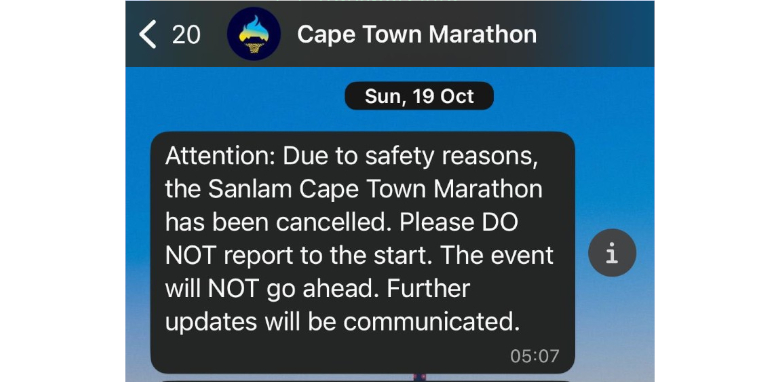
At 5am on Sunday, 19 October, a WhatsApp message went out to 22 000 runners: The Cape Town Marathon was cancelled – and hearts broke across the city.
As a parent whose son had spent months preparing for his first marathon, I got the call just after five: “Don’t worry to come, Mom. The marathon has been cancelled.” I was absolutely gobsmacked, not being able to comprehend how an event of such magnitude could be cancelled.
All I could say was: “They must have a very good reason. There’s no benefit to an event organiser to cancel their event on the morning of the race.”
There has been widespread discussion about whether the Cape Town Marathon organisers made the correct call in cancelling the event. Before jumping to any conclusions, it is important to look at the timeline of events leading up to this extremely difficult decision. This timeline is from notes made by the Sanlam Cape Town Marathon Safety Officer, Phil Prinsloo and posted on their website:
00h15 – First reports of high winds at the Race Village (including two start lines and the finish line) in Green Point, as well as at various points on the route.
02h00 – More reports of high winds at Race Village and along the route.
02h15 – Safety Walk inspection of Race Village observes damage at Start in Fritz Sonnenberg Road, with some infrastructure blown over. Damage also observed at Finish, with fencing blown over, and in Hospitality Area, where most gazebos and some furniture blown away. Wind meter readings taken of gusts up to 48km/h.
02h20 – Race organising team begins removing branding on fencing, repairing infrastructure (where possible) and clearing up race venue, in spite of ongoing strong winds.
02h30 – More damage in race venue observed: Stretch tent torn and blown away, Medical Tent brace dislodged. More gusts of 48km/h measured.
02h30 – Race Village officially shut down by safety officials and enforced by security staff. Event staff and volunteers as well as vendors not able to access, pass through or set up in any part of the Race Village, or gain access to equipment or supplies stored in Race Village and scheduled to be dispatched out onto route.
03h00 – Route Safety Team deployed to various sectors of route, report the following through regular feedback to the JOC:
Sea Point: Fencing and infrastructure at Start in Beach Road blown over or shifted into the road. Period of high wind conditions from 03h00 to 06h30.
Woodstock: Very high winds experienced, and by 04h30, all signage blown over, and traffic cones blown out of position.
Observatory & Rondebosch: Very high winds experienced, with gusts of more than 60km/h observed between 03h30 and 04h30, affecting fencing in this area.
04h15 – Report from Start of further infrastructure movement and unsafe situation.
04h40 – Report from Race Village and Observatory that the wind situation has not changed since 02h00, with
continuing gusts up to 46km/h. At this stage, nobody is able to predict if or when the wind will subside.
04h40 – Structural engineer reports that he cannot do final certification that the following structures are safe: Start towers on Fritz Sonnenberg, scaffold bridge on Vlei Road, hospitality marquee and shade stretch tents in Race Village, medical tents on route, pedestrian bridge on Vlei Road, main medical marquee at finish.
04h45 – Decision taken by Safety Committee to cancel the event, and JOC authorised the decision.
05h00 – Communication of cancellation goes out to all runners via direct WhatsApp messaging and on social media, urging them not to travel to the start venues. The cancellation announcement is also shared with local radio stations.
05h10 – Further reports of gusts up to 46km/h measured at Race Village and Observatory.
05h15 – Messaging displayed on all VMS boards leading to the city notifying inbound motorists of cancellation.
06h30 – First press release from the race office about the cancellation sent to all media platforms and partners.
According to Prinsloo: “The Sanlam Cape Town Marathon was managed in accordance with the Safety at Sports and Recreational Events Act (SASREA) of 2010…” which “….stipulates that the responsibility for ensuring safety and security lies with the event’s controlling body, organiser or venue owner, through its Event Safety Plan, which must consider all reasonably practicable duties, actions and operational procedures to mitigate the hazards and related risks that might arise.”
As such, the decision to cancel the race required a unanimous decision by all members of the JOC, taking into account all the reports received and the observations, concerns and opinions of a team of highly-qualified and experienced people.
Sanlam Cape Town Marathon CEO, Clark Gardner stated that all options were considered including a delayed start: “…as much as we tried to find a way to delay the start and come up with another plan, we just couldn’t guarantee the safety of our participants, spectators and crew, and that was something that is always paramount to us.”
As a parent of a devastated novice runner, and as a former event organiser and race director, I believe I’m in a unique position to offer a somewhat balanced perspective.
Experienced event organisers know it’s impossible to make a decision that pleases everyone. Had the marathon gone ahead and runners been injured, not only would it have been devastating for all concerned but the responsibility (and rightly so) would have fallen squarely on the organising committee. They faced a heartbreaking choice but made the call with courage and clarity, putting the safety of their participants above all else. They knew that cancelling would disappoint thousands and carry significant consequences, yet they chose to protect people first.
In my view, it was not only the bravest decision they could make – it was the only truly responsible one under the circumstances.
For a more detailed report from the Cape Town Marathon on the decision process see https://capetownmarathon.com/cancellation-timeline-of-the-2025-sanlam-cape-town-marathon/
|
|
SportSplits/FinishTime is proud to announce that once again, we have been awarded the timing and IT infrastructure contracts for Comrades for a period of 3 years i.e. 2026, 2027 & 2028.
Comrades is one of the largest and most important events that we are involved with. Over the Comrades period, our SportSplits/FinishTime team of around 60 staff members manage a wide range of functions from time keeping and data management to a host of other services.
The planning and implementation of the range of services that we provide starts months before race day and ends long after the last runner crosses the line. Monitoring the timing along the 89 km route on public roads is a complex, logistical challenge involving multiple timing points.
Here is a brief overview of the array of services we provide for the Comrades Marathon:
Race Timing:
Co-ordinate start times
Monitor timing check points
Monitor cut-off times
Medal hand out
Seeding
Batching
Timing chip programming
Live results
Results and prize giving sign off
Data management:
On-line entries
Athlete profiles and history
Medical questionnaire
Other Services:
Maintain and monitor the Comrades App
Video monitoring
Syncing all race clocks
Number printing and assigning
Registration process on mobile phones
Number collection
Proxy collection

|
|
The ISUZU IRONMAN 70.3 Mossel Bay is a triathlon event that takes place in the scenic coastal town of Mossel Bay, South Africa. It chalenges athletes with a 1.9km swim ,a single-loop 90km bike course, and a 21.1km run, consisting of two and a half loops that pass landmarks such as the harbour, historic Central Mossel Bay, the Dias Museum Complex, and The Point, culminating below the Cape St Blaize lighthouse.
|
 |